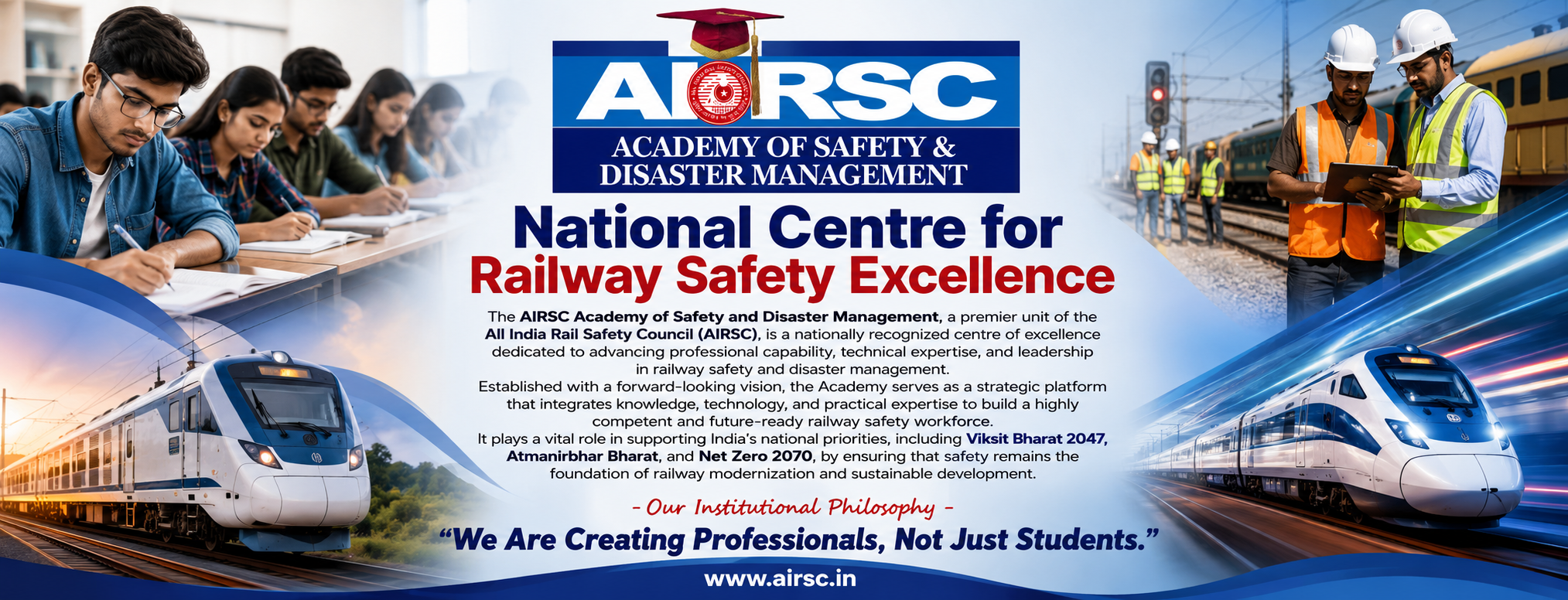
Public awareness materials promoting railway safety across India.
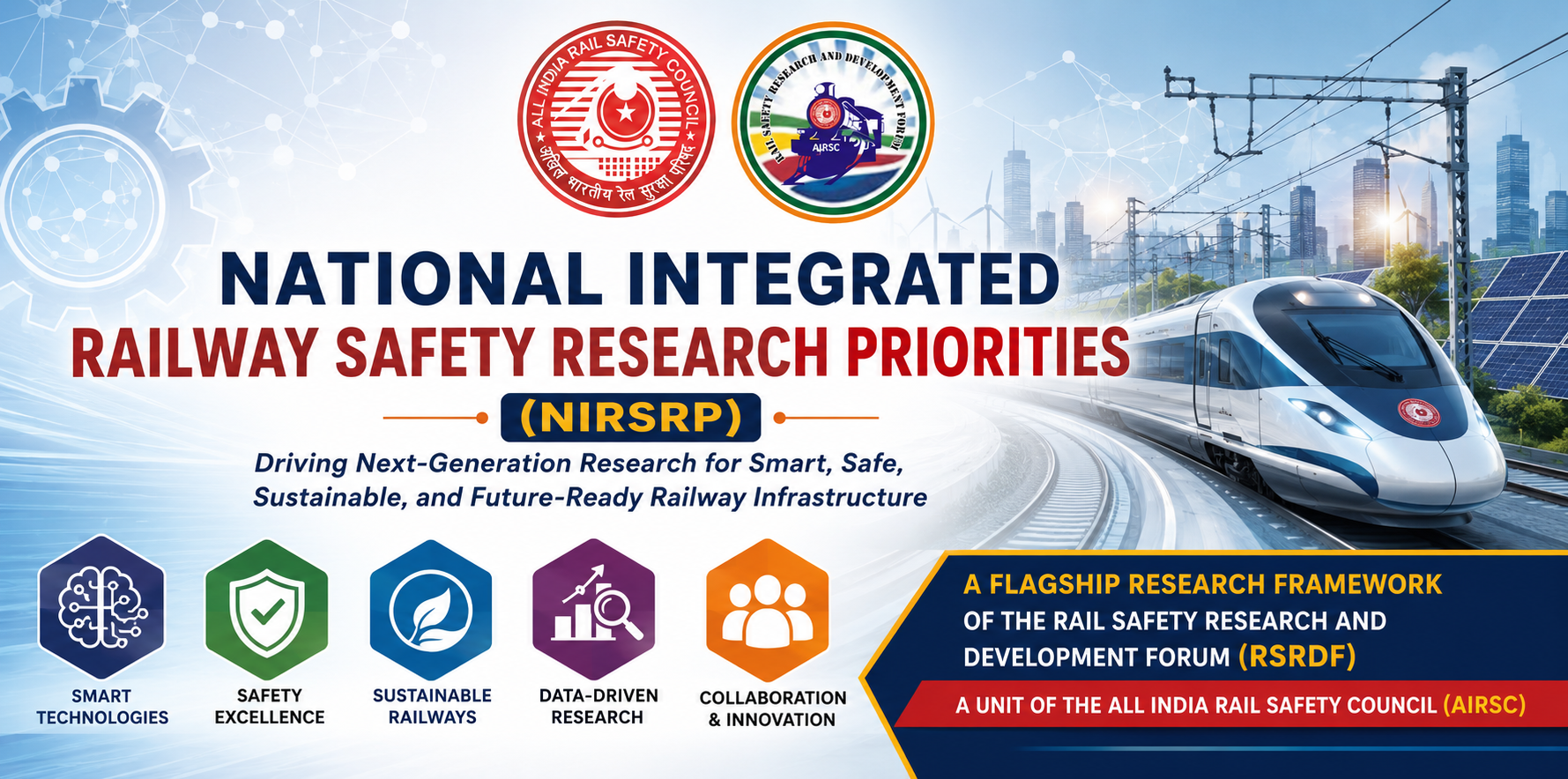
NATIONAL INTEGRATED RAILWAY SAFETY RESEARCH PRIORITIES (NIRSRP) DRIVING NEXT-GENERATION RESEARCH FOR SMART, SAFE, SUSTAINABLE, AND FUTURE-READY RAILWAY INFRASTRUCTURE A FLAGSHIP RESEARCH FRAMEWORK OF THE RAIL SAFETY RESEARCH AND DEVELOPMENT FORUM (RSRDF) A UNIT OF THE ALL INDIA RAIL SAFETY COUNCIL (AIRSC) The National Integrated Railway Safety Research Priorities (NIRSRP) is the principal research framework of the Rail Safety Research and Development Forum (RSRDF), a unit of the All India Rail Safety Council (AIRSC). It establishes a comprehensive roadmap for multidisciplinary research that supports the continuous advancement of railway safety, infrastructure resilience, operational excellence, digital transformation, and sustainable transportation. The framework identifies strategic research priorities that will shape the future of railway engineering, intelligent infrastructure, advanced technologies, asset management, and transportation innovation. It serves as a common platform for researchers, engineers, railway professionals, policymakers, academic institutions, technology providers, industry partners, and international organisations to collaborate on solutions that address the evolving challenges of modern railway systems. With India's railway sector undergoing rapid transformation through High-Speed Rail, Metro Rail expansion, Dedicated Freight Corridors, Digital Railways, Artificial Intelligence, predictive maintenance, smart infrastructure, and sustainable mobility, the need for coordinated, research-driven innovation has never been greater. The National Integrated Railway Safety Research Priorities provide a structured and future-oriented approach for developing technologies, engineering solutions, safety standards, operational strategies, and evidence-based policies that contribute to a safer, smarter, greener, and globally competitive railway ecosystem. The programme aligns with the national priorities of Viksit Bharat 2047, Atmanirbhar Bharat, Digital India, Make in India, PM Gati Shakti, the National Rail Plan, and the United Nations Sustainable Development Goals (SDGs). Vision To establish India as a global centre of excellence in railway safety research by creating an integrated research ecosystem that drives technological innovation, engineering excellence, operational safety, and sustainable infrastructure development. Mission The National Integrated Railway Safety Research Priorities aim to: • Define strategic research directions for future railway development. • Promote multidisciplinary collaboration across engineering, technology, management, and public policy. • Encourage indigenous innovation and scientific excellence. • Accelerate the adoption of advanced digital technologies. • Improve infrastructure reliability and operational resilience. • Support evidence-based decision-making and international best practices. • Build a knowledge-driven railway sector capable of meeting future transportation demands. Strategic Research Priorities Smart Railway Infrastructure Engineering Research on intelligent railway infrastructure incorporating advanced materials, smart sensors, digital monitoring, resilient engineering, and integrated asset management to improve long-term safety, durability, and operational performance. High-Speed Rail Infrastructure Development of engineering standards, track technologies, bridge systems, signalling integration, vibration control, and maintenance strategies to support safe, reliable, and high-performance high-speed rail operations. Metro Rail Systems Research focusing on urban rail mobility, automated operations, passenger safety, energy efficiency, intelligent stations, and integrated multimodal transportation solutions for rapidly growing metropolitan regions. Structural Health Monitoring Application of advanced sensing technologies, fibre optic systems, AI-based diagnostics, and real-time monitoring for continuous assessment of bridges, tunnels, viaducts, stations, and other critical railway structures. Intelligent Asset Management Development of lifecycle asset management frameworks using predictive analytics, digital engineering, condition-based maintenance, and risk-informed investment planning to optimise infrastructure performance. Artificial Intelligence Applications Research into Artificial Intelligence and Machine Learning for predictive maintenance, intelligent signalling, operational optimisation, anomaly detection, decision-support systems, and safety risk management. Digital Twins Development of digital replicas of railway infrastructure and operational systems to enable simulation, performance analysis, predictive maintenance, engineering optimisation, and strategic planning. Internet of Things (IoT) Integration of connected sensors and smart devices to provide real-time monitoring of railway assets, environmental conditions, equipment performance, and operational safety. Predictive Maintenance Research on advanced maintenance methodologies using AI, IoT, digital twins, and analytics to predict equipment failures, reduce maintenance costs, minimise downtime, and enhance system reliability. Robotics and Automation Application of robotic technologies for infrastructure inspection, maintenance operations, tunnel assessment, hazardous environment monitoring, automated construction, and emergency response. Drone Technologies Research into unmanned aerial systems for efficient inspection of railway tracks, bridges, overhead electrification, stations, construction projects, and remote infrastructure. Satellite Monitoring Use of satellite imagery, remote sensing, and geospatial technologies for infrastructure surveillance, land management, environmental monitoring, disaster assessment, and strategic planning. Railway Cyber-Physical Systems Development of secure and integrated cyber-physical systems connecting digital platforms with physical railway assets to improve automation, operational control, safety, and cybersecurity. GIS and BIM Applications Research on Geographic Information Systems (GIS) and Building Information Modelling (BIM) for infrastructure planning, digital asset management, lifecycle engineering, project execution, and operational decision-making. Climate Adaptation Engineering research addressing the impacts of climate change through resilient infrastructure design, flood protection, landslide mitigation, heat-resistant materials, and adaptive maintenance strategies. Sustainable Engineering Promotion of environmentally responsible engineering practices, green construction materials, renewable energy integration, circular economy principles, and sustainable infrastructure management. Energy-Efficient Infrastructure Research into energy optimisation, regenerative technologies, renewable energy systems, smart power management, and low-carbon railway infrastructure to improve environmental performance. Safety Risk Analytics Development of advanced analytical models for identifying, evaluating, predicting, and mitigating safety risks through data science, artificial intelligence, and quantitative risk assessment. Infrastructure Lifecycle Management Research focused on planning, design, construction, operation, maintenance, renewal, and disposal of railway assets to maximise long-term performance, safety, sustainability, and cost-effectiveness. Future Mobility Systems Exploration of emerging transportation technologies including autonomous rail systems, connected mobility, intelligent transportation networks, multimodal integration, hydrogen propulsion, battery-electric rail systems, and next-generation passenger mobility solutions. Cross-Disciplinary Research Framework The National Integrated Railway Safety Research Priorities encourage collaboration across multiple disciplines, including: • Railway Engineering • Civil Engineering • Mechanical Engineering • Electrical Engineering • Electronics and Communication • Artificial Intelligence • Computer Science • Cybersecurity • Data Science • Environmental Engineering • Disaster Management • Transport Planning • Urban Mobility • Economics • Public Policy • Human Factors Engineering • Safety Management • Sustainability Studies Research Implementation Strategy The framework supports: • National Collaborative Research Projects • Pilot Demonstration Programmes • Technology Validation and Field Trials • Innovation Incubation • Industry-Academia Partnerships • International Research Collaboration • Centres of Excellence • Research Fellowships • Technical Publications • Standards Development • Policy Research • Knowledge Repositories • Capacity Building and Professional Development The National Integrated Railway Safety Research Priorities are designed to deliver: • World-class railway safety research. • Intelligent and resilient railway infrastructure. • Faster adoption of advanced technologies. • Stronger operational safety and reliability. • Improved asset performance and lifecycle management. • Sustainable and climate-resilient railway systems. • Enhanced passenger and workforce safety. • Increased indigenous innovation and technological self-reliance. • Greater collaboration between government, academia, and industry. • Internationally benchmarked engineering and safety practices. The future of railway transportation depends on the ability to integrate engineering excellence with digital innovation, scientific research, sustainability, and collaborative knowledge. By defining clear national research priorities, RSRDF provides a strategic framework that supports the continuous evolution of India's railway sector while addressing future mobility challenges and strengthening national infrastructure. These priorities will help create a railway ecosystem that is safer, smarter, more efficient, environmentally responsible, and globally competitive. The Rail Safety Research and Development Forum (RSRDF), under the All India Rail Safety Council (AIRSC), is committed to advancing research that delivers practical, scalable, and impactful solutions for the railway sector. Through the National Integrated Railway Safety Research Priorities, we seek to unite researchers, engineers, academic institutions, technology companies, industry leaders, policymakers, and international partners in a shared mission to shape the future of railway safety and infrastructure. Together, we are building a national research ecosystem that promotes innovation, strengthens resilience, enhances operational excellence, and contributes to India's vision of Viksit Bharat 2047—creating a railway network that is recognised worldwide for its safety, intelligence, sustainability, and engineering excellence. Framework Motto "Research with Purpose • Innovation with Impact • Safety without Compromise." "Advancing Knowledge to Build the Railways of Tomorrow."
Download PDF →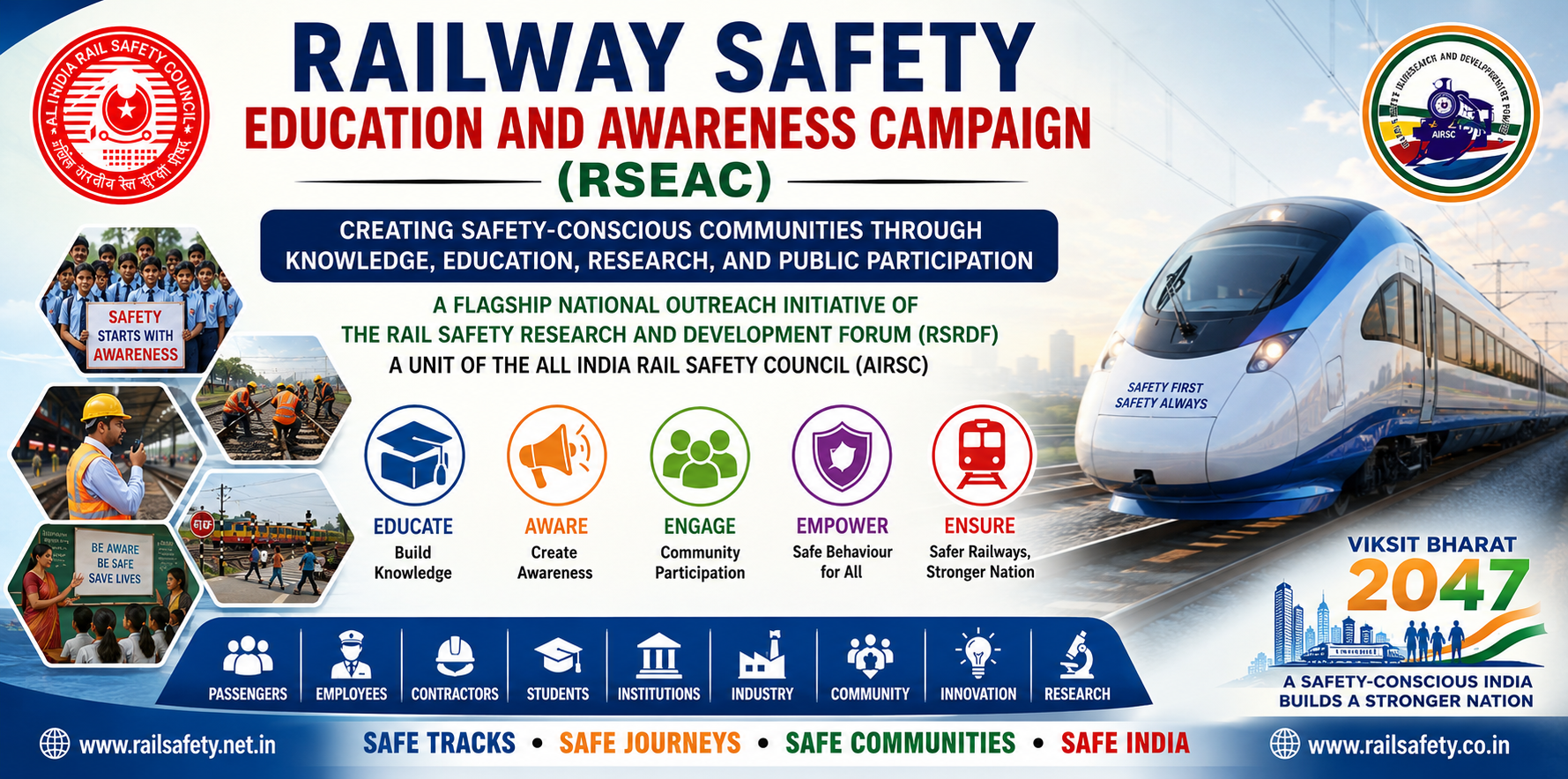
RAILWAY SAFETY EDUCATION AND AWARENESS CAMPAIGN (RSEAC) CREATING SAFETY-CONSCIOUS COMMUNITIES THROUGH KNOWLEDGE, EDUCATION, RESEARCH, AND PUBLIC PARTICIPATION A FLAGSHIP NATIONAL OUTREACH INITIATIVE OF THE RAIL SAFETY RESEARCH AND DEVELOPMENT FORUM (RSRDF) A UNIT OF THE ALL INDIA RAIL SAFETY COUNCIL (AIRSC) The Railway Safety Education and Awareness Campaign (RSEAC) is a flagship national initiative of the Rail Safety Research and Development Forum (RSRDF), a unit of the All India Rail Safety Council (AIRSC), dedicated to promoting a culture of railway safety through education, research, public awareness, professional engagement, and community participation. The campaign is founded on the principle that railway safety is a shared responsibility. While technological innovation, modern infrastructure, and effective regulations are essential, sustainable safety can only be achieved when passengers, railway employees, contractors, students, educational institutions, industries, and the general public understand and actively practice safe behaviour. RSEAC serves as a national knowledge and outreach platform designed to improve public understanding of railway safety, encourage responsible behaviour around railway infrastructure, strengthen professional competencies, and support evidence-based safety practices across India's railway, metro rail, suburban rail, freight, and high-speed rail networks. Aligned with the national vision of Viksit Bharat 2047, the campaign seeks to build a safety-conscious society where awareness, education, innovation, and responsible citizenship work together to prevent accidents and protect lives. Vision To build a nationally recognised railway safety culture where every citizen, passenger, employee, student, and stakeholder understands the importance of railway safety and actively contributes to creating a safer, smarter, and more resilient transportation system. Mission The Railway Safety Education and Awareness Campaign aims to: • Promote railway safety awareness among all sections of society. • Develop educational programmes that encourage safe behaviour around railway infrastructure. • Support continuous learning and professional development for railway personnel. • Strengthen community participation in accident prevention. • Encourage research-based public safety initiatives. • Promote innovation in railway safety communication and education. • Support national efforts to reduce preventable railway accidents. Strategic Objectives The campaign is designed to: • Build a nationwide culture of railway safety awareness. • Improve public understanding of railway rules and safe practices. • Encourage responsible behaviour at stations, platforms, tracks, and level crossings. • Promote safety education in schools, colleges, and universities. • Strengthen collaboration between railway organisations, educational institutions, industries, and communities. • Encourage innovation in safety education using digital technologies. • Develop future generations of railway safety ambassadors. The campaign promotes awareness in the following areas: • Passenger Safety • Platform Safety • Level Crossing Safety • Track Trespassing Prevention • Electrical Safety Around Railway Infrastructure • Emergency Preparedness • Fire and Life Safety • Safe Use of Railway Stations • Metro Rail Safety • High-Speed Rail Safety Awareness • Railway Disaster Preparedness • Workplace Safety • Occupational Health and Safety • Contractor Safety • Child and Youth Railway Safety Education • Women's Safety Awareness • Environmental Safety • Cyber Awareness for Digital Railway Systems • Community Participation in Railway Safety Education and Awareness Initiatives The campaign includes a comprehensive range of educational programmes such as: Railway Safety Awareness Programmes Public campaigns conducted at railway stations, schools, colleges, industries, workplaces, residential communities, and public institutions to promote responsible behaviour and accident prevention. School and College Safety Education Interactive educational programmes introducing students to railway safety through classroom sessions, competitions, demonstrations, educational materials, digital learning resources, and practical safety activities. These initiatives encourage young people to become Railway Safety Ambassadors within their communities. Community Outreach Programmes Awareness programmes conducted in villages, towns, urban communities, and locations adjacent to railway corridors, focusing on level crossing safety, trespassing prevention, emergency response, and community participation. Railway Employee Safety Education Continuous professional awareness programmes supporting railway employees through refresher training, safety campaigns, behavioural safety initiatives, and knowledge-sharing activities that reinforce operational excellence. Industry and Contractor Safety Awareness Specialised awareness programmes promoting safe work practices for contractors, construction personnel, maintenance teams, logistics providers, infrastructure developers, and industrial partners working in railway environments. Digital Safety Awareness Campaign Development of digital learning platforms, webinars, online courses, mobile applications, virtual simulations, e-learning modules, social media campaigns, and multimedia educational resources that extend railway safety education to wider audiences. Research-Based Public Education The Railway Safety Education and Awareness Campaign is supported by ongoing research that examines: • Public safety behaviour. • Human factors in railway operations. • Safety communication strategies. • Behavioural change models. • Community engagement methods. • Accident causation trends. • Risk perception studies. • Educational effectiveness. • Emerging public safety challenges. Research findings help design evidence-based educational programmes that improve safety outcomes and support national policy development. Capacity Building The campaign supports capacity development through: • Railway Safety Certification Programmes • Safety Leadership Workshops • Faculty Development Programmes • Student Internship Opportunities • Research Fellowships • Volunteer Training • Safety Ambassador Programmes • Professional Seminars • National Conferences • International Knowledge Exchange • Digital Learning Platforms Stakeholder Collaboration The campaign promotes collaborative partnerships with: • Indian Railways • Metro Rail Corporations • Railway Public Sector Undertakings • Railway Training Institutions • Educational Institutions • IITs, NITs, Universities, and Engineering Colleges • Schools and Teacher Training Institutions • Research Organisations • Government Departments • Local Authorities • Industry Associations • Technology Companies • Non-Governmental Organisations • Community Organisations • International Railway Organisations These partnerships strengthen outreach, encourage innovation, and help deliver consistent railway safety education across diverse communities. Innovative Awareness Tools To maximise public engagement, the campaign promotes the use of: • Interactive Safety Exhibitions • Mobile Awareness Vans • Railway Safety Museums • Digital Knowledge Portals • Virtual Reality (VR) Safety Simulations • Augmented Reality (AR) Learning Modules • Mobile Applications • Safety Games for Students • Educational Videos and Animations • Podcasts and Webinars • Social Media Campaigns • Digital Safety Newsletters • AI-Based Learning Platforms Expected Outcomes The Railway Safety Education and Awareness Campaign seeks to achieve: • Increased public awareness of railway safety. • Reduction in preventable unsafe behaviours. • Greater compliance with railway safety rules. • Improved community participation in accident prevention. • Stronger safety culture within railway organisations. • Enhanced knowledge among students and young professionals. • Better emergency preparedness and response. • Increased adoption of digital safety education. • Long-term behavioural change supporting safer railway operations. National Significance India operates one of the world's largest railway networks, serving millions of passengers and transporting vast quantities of freight every day. Protecting this network requires more than engineering excellence—it requires an informed and responsible society. The Railway Safety Education and Awareness Campaign contributes to national development by creating informed citizens, skilled professionals, responsible communities, and future leaders who understand that safety is fundamental to economic growth, sustainable mobility, and public welfare. The campaign supports India's aspiration to build a world-class railway system where safety is embedded in everyday behaviour and continuous learning. The Rail Safety Research and Development Forum (RSRDF), under the All India Rail Safety Council (AIRSC), is committed to making railway safety education accessible, practical, inclusive, and research-driven. Through the Railway Safety Education and Awareness Campaign, we aim to unite railway professionals, educational institutions, government agencies, industries, communities, and citizens in a shared mission to promote safety awareness, encourage responsible behaviour, and protect every life connected with the railway system. Together, we can build a future where knowledge inspires responsibility, innovation strengthens prevention, and every journey reflects the highest standards of railway safety. CAMPAIGN MOTTO "KNOWLEDGE CREATES AWARENESS • AWARENESS PREVENTS ACCIDENTS • SAFETY PROTECTS LIVES." "TOGETHER FOR SAFE RAILWAYS, STRONG COMMUNITIES, AND A SAFER INDIA."
Download PDF →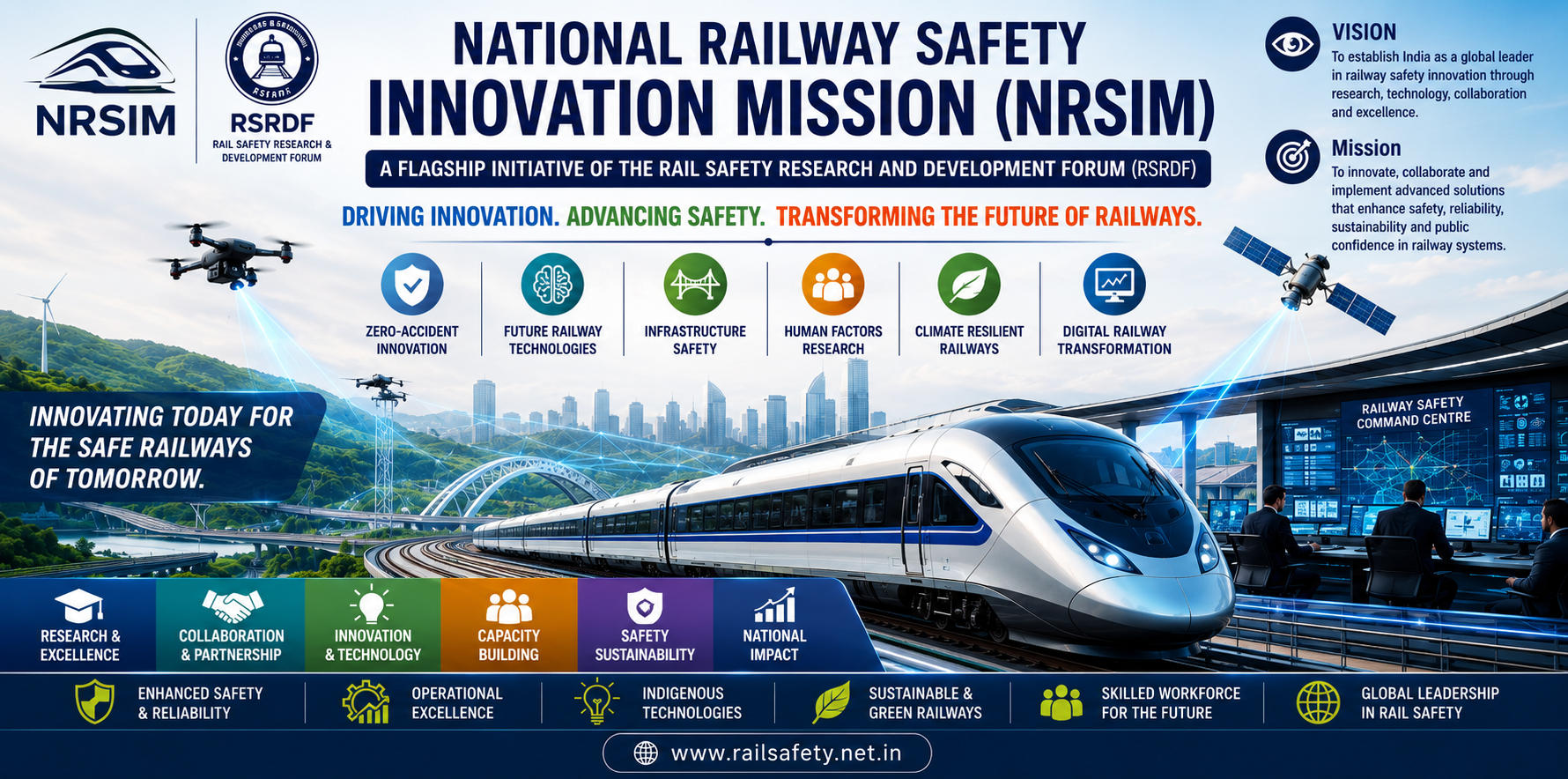
NATIONAL RAILWAY SAFETY INNOVATION MISSION (NRSIM) A FLAGSHIP INITIATIVE OF THE RAIL SAFETY RESEARCH AND DEVELOPMENT FORUM (RSRDF) DRIVING INNOVATION. ADVANCING SAFETY. TRANSFORMING THE FUTURE OF RAILWAYS. The National Railway Safety Innovation Mission (NRSIM) is a flagship strategic initiative of the Rail Safety Research and Development Forum (RSRDF), established to promote innovation, research excellence, advanced technologies, and collaborative solutions that strengthen the safety, security, reliability, and sustainability of railway transportation systems. NRSIM serves as a national platform that brings together researchers, railway professionals, policymakers, academic institutions, technology companies, startups, manufacturers, industry experts, and government organizations to jointly develop practical and future-ready safety solutions for the railway and metro rail sectors. As railway systems continue to evolve through high-speed rail, metro rail expansion, artificial intelligence, digital transformation, predictive maintenance, intelligent signalling, autonomous inspection technologies, and integrated transportation networks, safety innovation has become one of the most important pillars of national development. NRSIM is designed to accelerate this transformation by encouraging scientific research, indigenous technology development, applied engineering, and evidence-based policy recommendations that contribute to safer railway operations. The mission supports India's vision of creating a globally competitive, technologically advanced, and zero-accident railway ecosystem aligned with Viksit Bharat 2047, Atmanirbhar Bharat, Digital India, Make in India, and the United Nations Sustainable Development Goals (SDGs). Vision To establish India as a global leader in railway safety innovation by creating an integrated ecosystem of research, technology, education, policy development, and collaborative partnerships that continuously enhance railway safety, operational excellence, and public confidence. Mission The National Railway Safety Innovation Mission seeks to: Promote world-class research in railway safety and transportation systems. Develop innovative technologies that prevent accidents and improve operational reliability. Support indigenous design, engineering, and manufacturing of railway safety solutions. Strengthen collaboration between academia, industry, government, and research organizations. Encourage evidence-based policymaking and international best practices. Build a future-ready workforce equipped with advanced technical knowledge and innovation capabilities. Foster a proactive culture where prevention, continuous improvement, and technological excellence are integral to railway operations. Strategic Objectives Zero-Accident Innovation Advance research and technology aimed at significantly reducing operational risks, human errors, infrastructure failures, and accident occurrences across railway and metro systems. Future Railway Technologies Promote next-generation technologies including Artificial Intelligence (AI), Machine Learning, Internet of Things (IoT), Digital Twins, Big Data Analytics, Robotics, Drone-Based Inspection, Satellite Monitoring, Autonomous Systems, and Intelligent Transportation Solutions. Infrastructure Safety Develop innovative methods for monitoring railway tracks, bridges, tunnels, stations, signalling systems, electrification assets, rolling stock, and critical infrastructure using predictive and condition-based technologies. Human Factors Research Study behavioural safety, decision-making, fatigue management, ergonomics, competency development, organizational culture, and leadership practices to strengthen human performance and operational safety. Climate Resilient Railways Encourage research on flood resilience, extreme weather preparedness, environmental sustainability, green technologies, energy efficiency, and climate adaptation strategies. Digital Railway Transformation Support the development of integrated digital platforms that enhance real-time monitoring, predictive maintenance, cybersecurity, operational intelligence, and safety performance management. Core Areas of Research The mission promotes multidisciplinary research in: Railway Safety Engineering Metro Rail Safety High-Speed Rail Safety Railway Operations Management Signal and Telecommunication Systems Artificial Intelligence Applications Railway Cybersecurity Smart Railway Infrastructure Disaster Risk Reduction Emergency Management Fire and Life Safety Occupational Health and Safety Human Factors Engineering Risk Assessment and Safety Analytics Railway Asset Management Intelligent Mobility Systems Sustainable Railway Technologies Energy Management Rolling Stock Safety Freight Transportation Safety Passenger Safety Enhancement Innovation Ecosystem NRSIM creates a collaborative innovation ecosystem by connecting: Indian Railways Metro Rail Organizations Railway Production Units Railway Public Sector Undertakings Research Institutions Universities Engineering Colleges Technology Startups Manufacturing Industries International Railway Organizations Safety Professionals Consultants Professional Associations Policy Think Tanks Young Researchers and Students This collaborative approach encourages knowledge sharing, technology transfer, interdisciplinary research, pilot projects, and commercialization of innovative railway safety solutions. Flagship Programmes The National Railway Safety Innovation Mission will undertake several strategic programmes, including: National Railway Safety Innovation Challenge Smart Rail Technology Accelerator Programme AI for Railway Safety Initiative Railway Safety Startup Incubation Programme National Railway Research Fellowship Scheme Innovation Grants for Young Researchers Digital Railway Laboratory Network Railway Safety Data Intelligence Programme National Safety Analytics Centre Predictive Maintenance Research Initiative Railway Disaster Resilience Programme Railway Cybersecurity Innovation Centre Railway Human Factors Research Programme Green Railway Technology Mission Research Collaboration NRSIM actively promotes collaborative research through partnerships with: Government Ministries Railway Organizations Research Laboratories Universities International Institutions Engineering Associations Standards Organizations Technology Companies Public Sector Enterprises Private Industry Multidisciplinary Research Teams These collaborations facilitate knowledge exchange, joint publications, technology demonstrations, field validation, and international cooperation. Knowledge Development The mission encourages: Technical Publications Research Journals White Papers Policy Briefs Technical Standards Best Practice Guidelines Case Studies Innovation Reports Technical Manuals National Conferences International Seminars Expert Round Tables Digital Knowledge Repository Capacity Building Recognizing that innovation depends on skilled professionals, NRSIM supports: Professional Certification Programmes Executive Development Courses Faculty Development Initiatives Research Fellowships Student Innovation Projects Internship Programmes Technical Workshops Industry Exposure Visits Online Learning Platforms Innovation Competitions Leadership Development Programmes National Impact The National Railway Safety Innovation Mission is expected to contribute significantly to: Reduction in railway accidents and operational risks. Enhanced passenger and workforce safety. Adoption of globally benchmarked safety technologies. Strengthened research and innovation capabilities. Improved infrastructure reliability and resilience. Increased operational efficiency and service quality. Development of indigenous railway technologies. Enhanced disaster preparedness and emergency response. Creation of high-value research and technical employment. Promotion of sustainable and environmentally responsible railway systems. Positioning India as a global centre for railway safety research and technological innovation. The Rail Safety Research and Development Forum (RSRDF), through the National Railway Safety Innovation Mission (NRSIM), is committed to fostering a culture of innovation, scientific excellence, collaboration, and continuous improvement that supports the long-term advancement of railway safety in India. By integrating research, technology, education, policy development, and industry partnership, NRSIM aspires to create a safer, smarter, more resilient, and globally competitive railway system that protects lives, strengthens public confidence, and contributes meaningfully to India's vision of becoming a developed nation by 2047. "Innovating Today for the Safe Railways of Tomorrow."
Download PDF →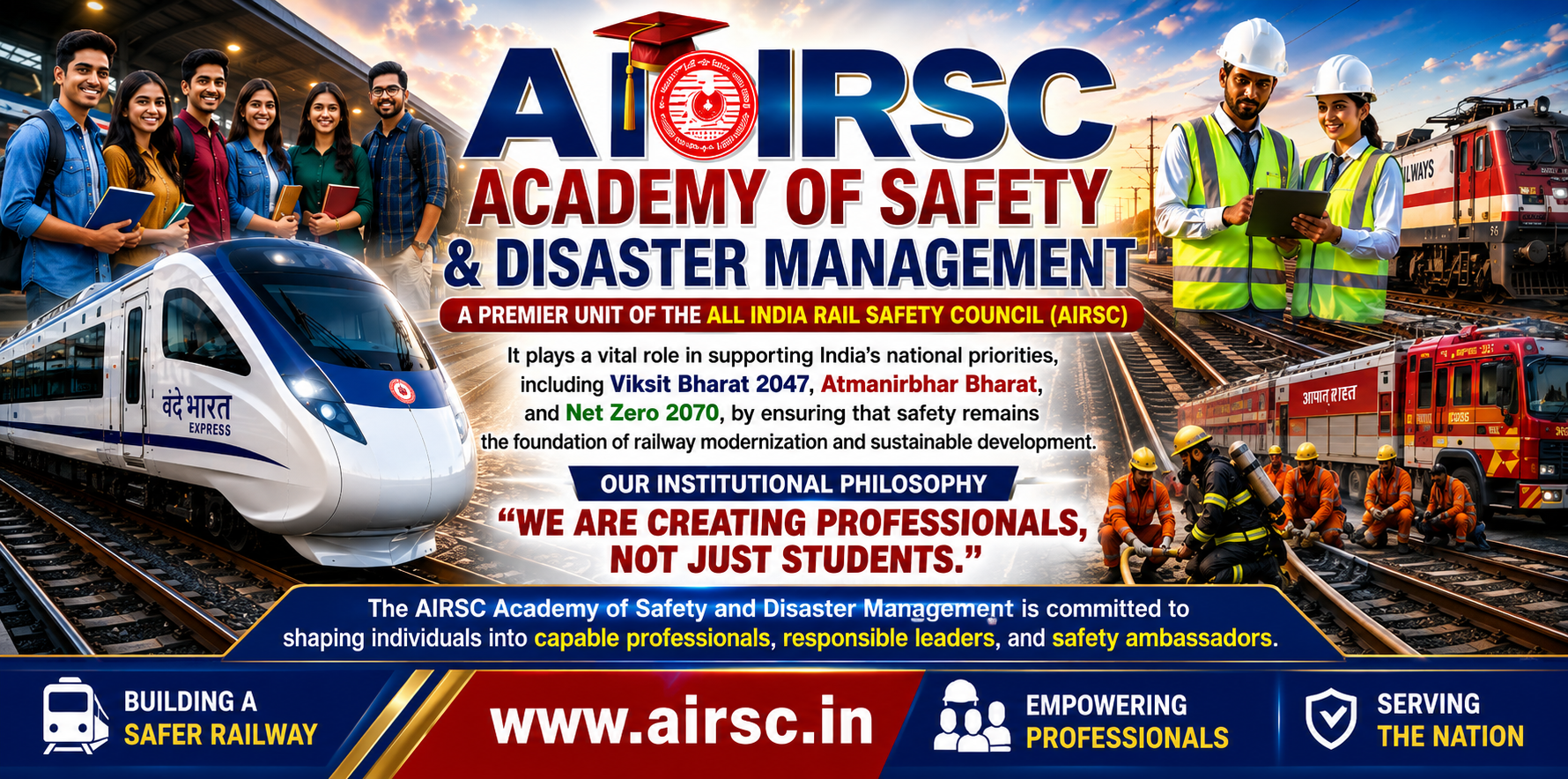
AIRSC ACADEMY OF SAFETY AND DISASTER MANAGEMENT (AASDM) A Unit of the All India Rail Safety Council (AIRSC) National Centre for Excellence in Railway Safety, Disaster Management, Professional Education and Future-Ready Workforce Development "Knowledge • Safety • Innovation • Leadership" "Creating Professionals for Safer Railways and a Stronger Nation" "We Create Employees, Not Just Students." About the Academy The AIRSC Academy of Safety and Disaster Management (AASDM) is the premier academic, professional, and research institution of the All India Rail Safety Council (AIRSC), established with the vision of developing highly skilled, professionally competent, and safety-oriented human resources for India's rapidly evolving railway, metro rail, transportation, industrial, infrastructure, logistics, manufacturing, and disaster management sectors. As India's transportation infrastructure continues to expand through High-Speed Rail, Metro Rail Systems, Dedicated Freight Corridors, Smart Railway Technologies, Artificial Intelligence, Digital Rail Operations, and Integrated Safety Management Systems, the demand for qualified safety professionals has never been greater. AASDM serves as a national platform for education, professional certification, executive development, applied research, capacity building, and industry collaboration, producing competent professionals who can lead the future of railway safety, disaster resilience, operational excellence, and infrastructure sustainability. The Academy combines academic excellence, industry relevance, practical learning, technological innovation, and professional ethics to prepare students and working professionals for leadership roles in one of the world's fastest-growing transportation sectors. Our Vision To become India's leading institution for railway safety education, disaster management, professional excellence, and technological innovation, supporting the transformation of Indian Railways into one of the safest, smartest, and most resilient railway systems in the world. Our Mission • Develop globally competent railway safety professionals. • Promote excellence in railway and metro safety education. • Advance research, innovation, and policy development. • Strengthen disaster preparedness and emergency response capabilities. • Support national infrastructure safety through skilled manpower. • Foster leadership, ethics, sustainability, and operational excellence. • Contribute to Viksit Bharat 2047, Atmanirbhar Bharat, and Make in India. Why Choose AASDM? The AIRSC Academy is distinguished by its unique focus on the railway and transportation sector. Its programmes are designed with direct industry relevance and emphasize practical competence, safety leadership, and future-ready skills. Key Strengths • Specialized Railway & Metro Safety Education • Industry-Oriented Curriculum • National-Level Professional Certifications • Experienced Railway and Industry Experts • Technology-Driven Learning • Research & Innovation Focus • Practical Exposure & Case Studies • Leadership Development • Skill-Based Professional Training • Career-Oriented Programmes • Continuous Professional Development • Strong Focus on Employability Academic Programmes Master of Business Administration (MBA) MBA in Rail Safety Management Develops professionals capable of leading railway safety systems, operational risk management, safety governance, accident prevention, and regulatory compliance. MBA in Rail Entrepreneurship and Governance Prepares future leaders to manage railway enterprises, public-private partnerships, policy development, innovation, infrastructure projects, and strategic governance. MBA in Rail Transport Economics Focuses on railway economics, transport planning, logistics, freight systems, financial management, infrastructure investment, and sustainable transport policy. MBA in Disaster Management Equips professionals with expertise in disaster risk reduction, emergency preparedness, crisis leadership, resilience planning, humanitarian response, and business continuity management. Bachelor Degree Programme B.Tech in Safety Engineering A multidisciplinary engineering programme emphasizing industrial safety, railway safety engineering, fire protection systems, occupational health, risk assessment, process safety, environmental protection, and modern safety technologies. Diploma Programmes Diploma in Rail Safety Management Designed for students seeking specialized knowledge in: • Railway Operations • Safety Management • Accident Prevention • Risk Assessment • Track Safety • Passenger Safety • Operational Excellence Post Graduate Diploma Programmes PG Diploma in Rail Safety Management PG Diploma in Rail Marketing and Branding PG Diploma in Industrial Safety Management PG Diploma in Disaster Management These programmes provide advanced professional knowledge in their respective disciplines and prepare candidates for leadership positions across railway, metro, industrial, logistics, infrastructure, and public safety sectors. Professional Certificate Courses The Academy offers specialized certificate programmes designed to meet emerging industry requirements. Railway & Metro Safety • Certificate in Metro Rail Safety & Risk Management • Certificate in Metro Rail Technology • Certificate in Railway Signalling and Telecommunication Technologies Disaster & Emergency Management • Certificate in Disaster Management Fire & Industrial Safety • Certificate in Fire & Safety Management These programmes provide practical skills, technical competence, and industry-recognized professional knowledge for students and working professionals. International Standard Short-Term Professional Courses To meet global industry standards, AASDM offers internationally benchmarked executive training programmes. Functional Safety – IEC 61508 (Rail & Metro) International principles of safety lifecycle management for safety-related electrical, electronic, and programmable systems. Functional Safety – EN 5012x (Rail & Metro) European railway safety standards covering RAMS (Reliability, Availability, Maintainability, and Safety), software assurance, and system safety engineering. IRIS (ISO 22163) – Rail Quality Management Professional training on the International Railway Industry Standard for quality management, supply chain excellence, and continuous improvement. Behaviour Based Safety (BBS) Development of proactive safety culture through behavioural observation, leadership engagement, and human-factor-based accident prevention. Industrial Safety Training Comprehensive training covering occupational safety, hazard identification, risk management, legal compliance, emergency preparedness, and workplace safety excellence. Industry-Focused Learning The Academy integrates education with real-world industry practices through: • Railway Safety Projects • Metro Rail Case Studies • Industrial Site Exposure • Safety Audits • Disaster Simulation Exercises • Emergency Response Training • Research Assignments • Leadership Workshops • Professional Seminars • Industry Interaction Programmes • Technical Conferences • National Safety Campaigns Career Opportunities Graduates of AASDM are prepared for careers in: • Indian Railways • Metro Rail Corporations • High-Speed Rail Projects • Dedicated Freight Corridors • Railway Manufacturing Industries • Rolling Stock Companies • Railway Infrastructure Projects • Railway Safety Organisations • Disaster Management Authorities • Industrial Safety Departments • Oil & Gas Industries • Power Plants • Airports • Ports • Logistics Companies • Infrastructure Development Organisations • Smart City Projects • Government Departments • Public Sector Undertakings • Private Engineering Companies • International Railway Projects • Safety Consultancy Organisations National Commitment The AIRSC Academy actively contributes to national development by promoting: • Railway Safety Excellence • Disaster Resilience • Skilled Workforce Development • Digital Transformation • Artificial Intelligence in Railways • Smart Transportation Systems • Sustainable Infrastructure • Innovation & Research • Indigenous Technology Development • Capacity Building • Safety Leadership • Human Capital Development The Academy aligns its educational mission with the national initiatives of Viksit Bharat 2047, Atmanirbhar Bharat, Make in India, Digital India, Skill India, and the National Education Policy (NEP), nurturing professionals who can support India's journey toward world-class transport infrastructure. Our Core Values • Safety First • Professional Integrity • Excellence in Education • Innovation • Research & Development • Leadership • Sustainability • National Service • Lifelong Learning • Social Responsibility Our Motto "We Create Employees, Not Just Students." "Knowledge Builds Competence • Competence Builds Safety • Safety Builds the Nation." "Empowering Professionals for Safe, Smart and Sustainable Railways." "Learning Today… Leading Tomorrow." "Building Future Railway Leaders Through Education, Innovation and Excellence." "Safe Tracks • Skilled Professionals • Strong Nation." AIRSC ACADEMY OF SAFETY AND DISASTER MANAGEMENT (AASDM) A Unit of the All India Rail Safety Council (AIRSC) National Centre for Railway Safety Excellence Advancing Education • Research • Innovation • Disaster Resilience • Professional Excellence Preparing the Next Generation of Railway Safety Leaders for India and the World.
Download PDF →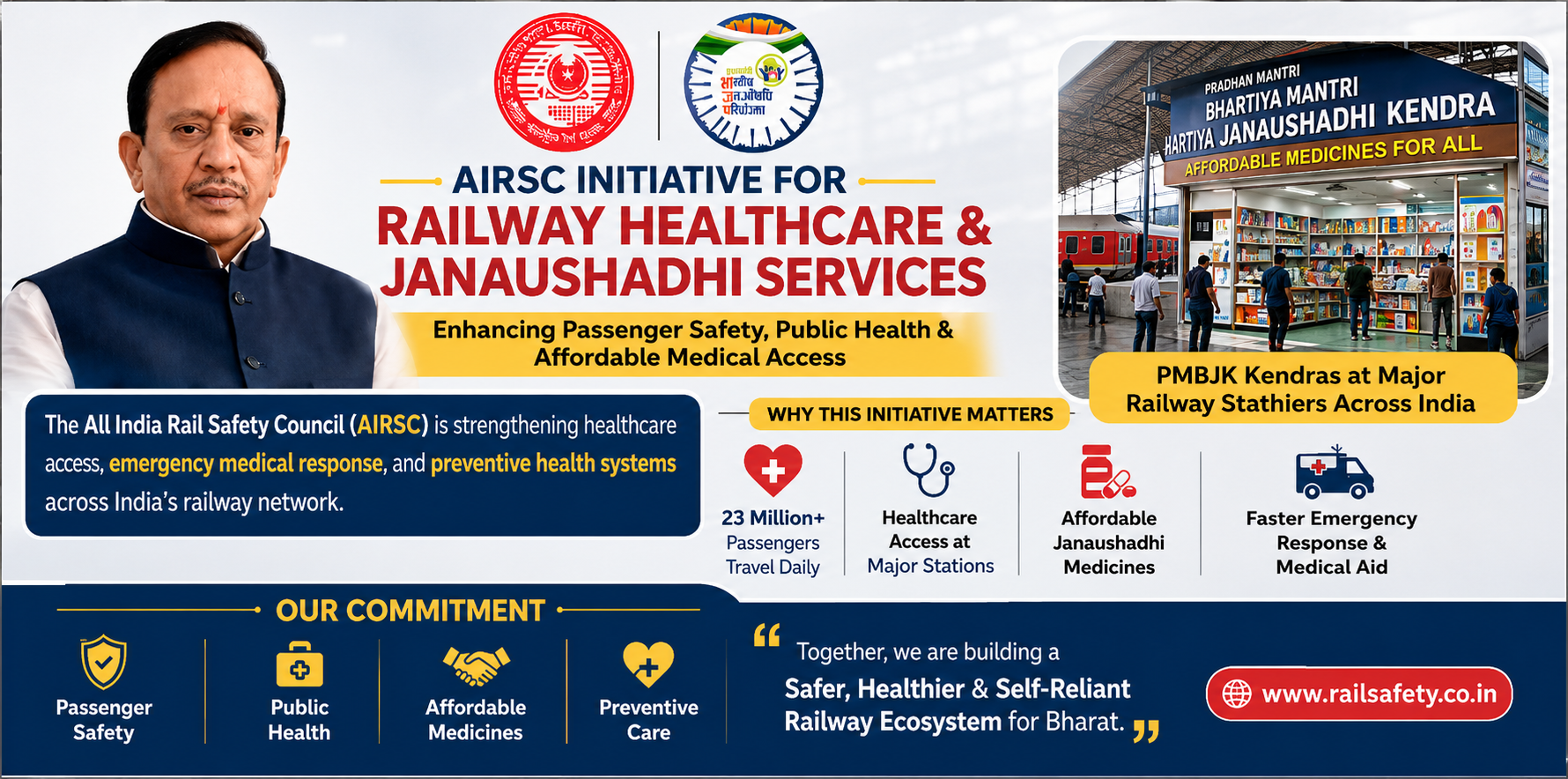
NATIONAL HEALTHCARE INITIATIVE FOR INDIAN RAILWAYS ESTABLISHMENT OF PRADHAN MANTRI BHARTIYA JANAUSHADHI KENDRAS (PMBJKS) AT MAJOR RAILWAY STATIONS ACROSS INDIA STRENGTHENING RAILWAY SAFETY THROUGH AFFORDABLE HEALTHCARE A NATIONAL INITIATIVE OF THE ALL INDIA RAIL SAFETY COUNCIL (AIRSC) The All India Rail Safety Council (AIRSC) is a national professional organization dedicated to promoting railway safety, public welfare, research, education, capacity building, and operational excellence across India's railway and metro systems. Recognizing that public health is an integral component of railway safety, AIRSC has undertaken a comprehensive study on establishing Pradhan Mantri Bhartiya Janaushadhi Kendras (PMBJKs) at major railway stations throughout the country. Indian Railways is one of the world's largest transportation networks, carrying nearly 23 million passengers every day and serving as the backbone of India's economy and social mobility. Every railway station functions not only as a transport hub but also as a public service centre where millions of passengers, railway employees, senior citizens, women, children, differently-abled persons, migrant workers, and economically weaker sections converge every day. In such a vast and dynamic environment, timely access to affordable medicines and basic healthcare services is not merely desirable—it is a national necessity. AIRSC therefore proposes the integration of Pradhan Mantri Bhartiya Janaushadhi Kendras (PMBJKs) within strategically identified railway stations to strengthen healthcare accessibility while complementing the safety objectives of Indian Railways. This initiative is fully aligned with the Government of India's vision of Affordable Healthcare for All, Viksit Bharat 2047, Atmanirbhar Bharat, Digital India, and the objective of creating a healthy, productive and resilient nation. Vision To establish a nationwide network of Pradhan Mantri Bhartiya Janaushadhi Kendras across major railway stations, providing affordable, high-quality medicines and essential healthcare services while supporting railway safety, passenger welfare, emergency medical preparedness, and employee health. Mission To integrate accessible healthcare infrastructure into India's railway ecosystem by creating professionally managed PMBJK centres that provide affordable medicines, preventive healthcare services, emergency medical support, and wellness facilities for railway passengers, employees, and the general public. Why Railway Stations Need PMBJKs Railway stations are among the busiest public places in India. Millions of people spend several hours travelling every day, and many passengers include elderly citizens, children, patients undergoing treatment, pregnant women, tourists, and people travelling long distances. Medical emergencies frequently arise due to: • Sudden illness during travel • Chronic diseases requiring regular medication • Hypertension and cardiac emergencies • Diabetes-related complications • Respiratory disorders • Fever and infections • Heat stroke and dehydration • Injuries during boarding or alighting • Accidental falls • Long-distance travel fatigue In many situations, passengers are unable to obtain affordable medicines immediately after arriving at a station. The availability of PMBJKs would significantly reduce delays in treatment and improve emergency response capabilities. Healthcare and Railway Safety – A Critical Relationship Railway safety extends beyond engineering systems, signalling, rolling stock, and infrastructure. It equally depends upon the physical and mental well-being of railway personnel responsible for train operations. Medical fitness is therefore a critical element of operational safety. Each year Indian Railways conducts approximately: • 50,000 Pre-Employment Medical Examinations (PEME) for recruitment of safety category staff. • 1,20,000 Periodical Medical Examinations (PME) for serving railway employees working in safety-sensitive positions. These examinations ensure that employees remain medically fit to perform duties affecting train operations and passenger safety. PMBJKs located at important railway stations can complement this healthcare ecosystem by ensuring continuous availability of essential medicines prescribed during these medical examinations. Passenger Healthcare During Travel Every year, thousands of railway passengers experience medical emergencies while travelling. Common situations include: • High fever • Blood pressure fluctuations • Diabetes-related emergencies • Asthma attacks • Minor injuries • Food poisoning • Motion sickness • Gastrointestinal disorders • Allergic reactions • Heat exhaustion • Dehydration The presence of PMBJKs at railway stations would enable immediate availability of quality generic medicines, reducing suffering and improving medical outcomes until specialized treatment becomes available. Railway Accident and Emergency Preparedness Indian Railways responds annually to hundreds of railway accidents and untoward incidents requiring coordinated medical assistance. During emergencies, immediate access to medicines, dressings, surgical consumables, first-aid materials, emergency pharmaceuticals, and healthcare logistics becomes essential. PMBJKs can function as valuable support centres by: • Supplying emergency medicines • Supporting first-aid teams • Assisting disaster response personnel • Providing medical consumables • Supporting relief operations • Strengthening emergency preparedness Such integration would enhance the overall resilience of the railway disaster management framework. Affordable Medicines for Millions One of the greatest strengths of the Pradhan Mantri Bhartiya Janaushadhi Pariyojana (PMBJP) is its commitment to making quality medicines affordable for every citizen. The initiative provides: • High-quality generic medicines • WHO-GMP compliant pharmaceutical products • Significant savings compared with branded medicines • Medicines covering all major therapeutic categories • Surgical consumables • Healthcare products • Medical devices The continuously expanding PMBJP product basket includes: • Essential medicines • Surgical products • Cardiac stents • Orthopaedic implants • Healthcare consumables • Wellness products • Diagnostic accessories This makes PMBJKs ideal healthcare centres for railway passengers. Benefits to Railway Employees The initiative would also greatly benefit railway employees by: • Improving access to affordable medicines • Supporting occupational health programmes • Reducing treatment costs • Enhancing continuity of medication • Supporting preventive healthcare • Improving employee wellness • Assisting in long-term disease management • Helping reduce sickness-related absenteeism Improved employee health directly contributes to safer railway operations and higher productivity. Social Impact The proposed PMBJK network would provide substantial benefits to: Senior Citizens Easy access to affordable medicines during railway travel. Women Affordable healthcare support for women travelling alone and homemakers from economically weaker families. Differently-Abled Persons Convenient availability of medicines and healthcare products without travelling long distances. Economically Weaker Sections Substantial savings on essential medicines through quality generic alternatives. Railway Employees Continuous access to affordable healthcare for employees and their families. Tourists and Pilgrims Reliable healthcare support while travelling across India. General Public Community healthcare services accessible through railway infrastructure. Strategic Advantages The initiative offers several long-term national benefits: • Improved passenger satisfaction • Enhanced public confidence in Indian Railways • Stronger emergency medical preparedness • Better occupational health support • Increased healthcare accessibility • Promotion of preventive healthcare • Reduced out-of-pocket medical expenditure • Better integration between healthcare and transport infrastructure • Support for public health during disasters • Contribution towards universal healthcare objectives Alignment with National Priorities The proposed initiative directly supports: • Pradhan Mantri Bhartiya Janaushadhi Pariyojana (PMBJP) • Ayushman Bharat • Viksit Bharat 2047 • Atmanirbhar Bharat • Digital India • Healthy India Mission • National Health Policy • Sustainable Development Goals (SDGs), particularly: o SDG 3 – Good Health and Well-being o SDG 9 – Industry, Innovation and Infrastructure o SDG 10 – Reduced Inequalities o SDG 11 – Sustainable Cities and Communities o SDG 17 – Partnerships for the Goals AIRSC's Proposed Implementation Framework The All India Rail Safety Council proposes a phased implementation strategy beginning with: • Major Railway Junctions • State Capital Stations • Divisional Headquarters • A1 and NSG Category Stations • High Passenger Density Stations • Pilgrimage Railway Stations • Tourist Destinations • Metro-Rail Interchange Stations • Industrial Corridor Stations The project may subsequently be expanded to cover additional railway stations across India based on passenger volume and regional healthcare needs. The establishment of Pradhan Mantri Bhartiya Janaushadhi Kendras at major railway stations represents a transformative national initiative that combines public healthcare, passenger welfare, employee wellness, and railway safety into a single integrated service model. By bringing affordable medicines closer to millions of railway passengers and employees, the initiative will significantly strengthen India's healthcare delivery system while enhancing the resilience and humanitarian dimension of railway infrastructure. The All India Rail Safety Council (AIRSC) believes that safe transportation must be supported by accessible healthcare. Integrating PMBJKs into the railway ecosystem will create healthier passengers, healthier employees, stronger emergency preparedness, and a more compassionate public transport system. This initiative is envisioned as a meaningful contribution toward building a Safe Railway, Healthy Citizens, and a Developed India, fully aligned with the national aspirations of Viksit Bharat 2047. Dr. R. Padmanabhan Chairman All India Rail Safety Council (AIRSC) "Strengthening Railway Safety Through Knowledge, Innovation, Healthcare and National Service."
Download PDF →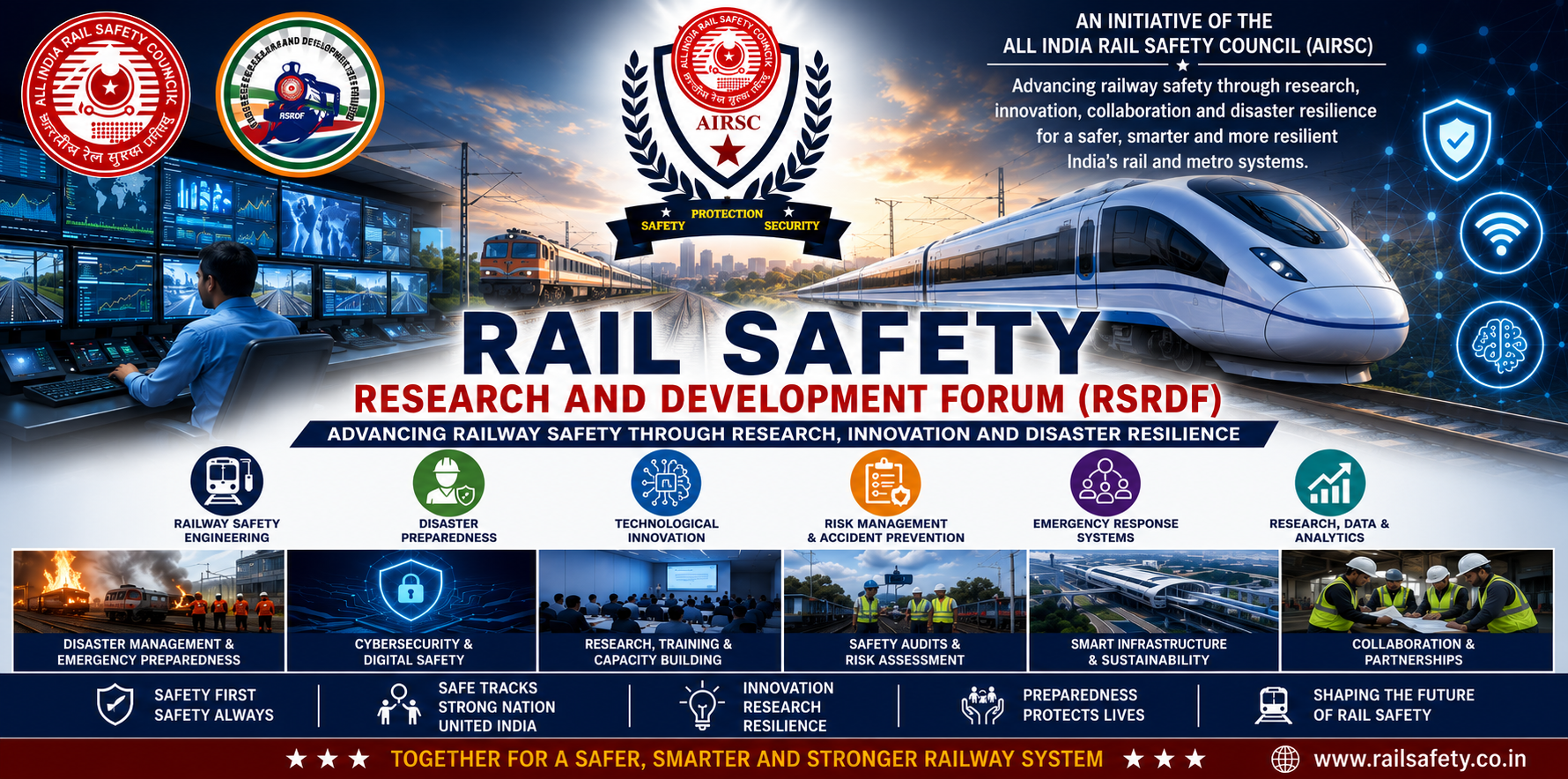
National Vision Alignment Viksit Bharat Railways 2047 – A Developed India Vision The All India Rail Safety Council aligns its long-term strategy with the national mission of Viksit Bharat 2047, supporting the transformation of Indian Railways into a world-class, safe, smart, and resilient transportation system. AIRSC envisions a future where railway safety is technology-driven, globally benchmarked, and centered on human life and national progress. Key Focus Areas • Advancing the Zero-Accident Railway Vision for a safer India • Adoption of world-class railway safety standards and global best practices • Integration of advanced digital, intelligent, and predictive safety systems • Strengthening disaster resilience and emergency preparedness across the network • Enhancing passenger safety, reliability, and public confidence • Building a future-ready, highly skilled railway safety workforce • Developing a smart, data-driven, and technology-enabled railway safety ecosystem Make in India – Self-Reliant Railway Safety Systems AIRSC actively supports the national Make in India initiative by encouraging indigenous development, innovation, and deployment of railway safety technologies. The Council promotes self-reliance and strengthens India’s capability to design, manufacture, and implement advanced safety solutions. Key Focus Areas • Promotion of indigenous railway safety technologies and innovation • Support for domestic manufacturing of safety equipment and protection systems • Encouragement to Indian research institutions, startups, and safety innovators • Localization of modern safety tools, monitoring systems, and diagnostics • Capacity building and skill development for Indian safety professionals and engineers • Strengthening India’s global leadership in railway safety and safety engineering Net Zero 2070 – Sustainable & Green Railway Safety AIRSC integrates environmental sustainability into its safety framework, aligning with India’s Net Zero Carbon Emission 2070 commitment. The Council promotes safe, sustainable, and climate-resilient railway operations to protect both people and the environment. Key Focus Areas • Promotion of environmentally responsible railway safety practices • Energy-efficient and sustainable safety infrastructure development • Climate-resilient railway safety and disaster management systems • Reduction of environmental and operational risks • Adoption of eco-friendly materials and green safety technologies • Integration of safety, sustainability, and long-term resilience planning Introduction The All India Rail Safety Council (AIRSC) is a premier national forum dedicated to strengthening railway safety, risk reduction, accident prevention, and disaster resilience across the Indian railway ecosystem. Through research, training, technology promotion, and stakeholder collaboration, AIRSC plays a pivotal role in advancing a Zero-Accident Vision for India’s rail transport system. AIRSC works closely with railway professionals, safety regulators, academic institutions, industry experts, and disaster management authorities to develop practical, technology-driven, and human-centric safety solutions. Major AIRSC Projects & Initiatives 1. National Rail Safety Research & Development Programme AIRSC promotes scientific and evidence-based approaches to railway safety through dedicated research initiatives. Key Focus Areas • Accident causation analysis and risk mapping • Track, signaling, and rolling stock safety studies • Human factors and safety behaviour research • Safety performance benchmarking • Data-driven accident prevention models Impact • Supports policy makers and railway administrators • Improves predictive safety planning • Strengthens evidence-based decision making 2. Railway Disaster Management & Emergency Preparedness Programme This flagship initiative enhances preparedness and response capability for railway emergencies and disasters. Core Components • Disaster response planning and simulation exercises • Incident Command System (ICS) training • Multi-agency coordination frameworks • Fire, derailment, collision, and natural disaster response strategies • Emergency evacuation and rescue procedures Outcome • Improved response time and coordination • Enhanced resilience of railway systems • Reduced loss of life and property 3. National Railway Safety Training & Capacity Building Mission AIRSC conducts specialized safety education and professional training for railway personnel, contractors, and safety practitioners. Training Domains • Railway safety management systems (SMS) • Workplace safety and hazard control • Track and infrastructure safety • Electrical and mechanical safety • Safety leadership and safety culture • Occupational health & industrial safety Key Achievements • Thousands of safety professionals trained • Promotion of safety-first work culture • Standardized safety competency frameworks 4. Rail Safety Awareness & Public Safety Campaigns AIRSC runs nationwide campaigns to improve safety awareness among railway staff, passengers, and the general public. Major Campaign Themes • Level crossing safety • Anti-trespassing awareness • Passenger safety and emergency preparedness • Fire safety and onboard safety awareness • Safety behaviour and responsibility Social Impact • Reduction in preventable incidents • Improved public cooperation in safety matters • Strengthened community safety engagement 5. Technology Promotion & Safety Innovation Initiative AIRSC actively supports adoption of modern safety technologies in railway operations. Focus Areas • Automatic Train Protection (ATP) systems • Collision prevention and signaling modernization • Safety monitoring and predictive analytics • AI-based safety surveillance systems • Smart inspection and safety diagnostics Objective • Encourage modernization and digital safety transformation • Promote innovation-driven accident prevention 6. Rail Safety Audit, Risk Assessment & Consultancy Services AIRSC provides expert advisory and safety audit services for railway organizations and infrastructure projects. Services Include • Comprehensive safety audits • Risk identification and mitigation planning • Safety compliance evaluation • Accident investigation and root cause analysis • Safety improvement roadmaps Value • Strengthens organizational safety governance • Helps achieve regulatory and operational safety excellence 7. National Rail Safety Conference & Knowledge Forum AIRSC organizes annual conferences, seminars, and knowledge-sharing platforms bringing together leading safety experts and institutions. Objectives • Exchange of best practices and innovations • Presentation of research and safety case studies • Policy dialogue and strategic discussions • Networking among safety professionals Contribution • Builds a national safety knowledge ecosystem • Encourages continuous learning and collaboration 8. Safety Standards, Policy Advocacy & Strategic Advisory AIRSC contributes to development of safety frameworks, guidelines, and policy recommendations. Areas of Work • Safety standards and procedural guidelines • Safety culture and leadership development • Strategic safety planning • Advisory to institutions and safety bodies Outcome • Strengthened national safety framework • Alignment with global best practices 9. Occupational Safety, Health & Industrial Risk Reduction Programme AIRSC promotes safe working environments for railway employees and contractors. Focus • Workplace hazard management • Industrial accident prevention • PPE and safe work procedures • Health, fatigue, and human performance • Safety behaviour and leadership Result • Safer workforce and improved operational reliability 10. Vision Zero – National Railway Accident Prevention Mission AIRSC’s long-term strategic initiative aimed at achieving Zero Fatalities and Zero Major Accidents in railway operations. Strategic Pillars • Prevention through technology • Competency through training • Awareness through education • Resilience through preparedness • Leadership through safety culture Future Strategic Directions AIRSC continues to expand its role in: • Smart and Digital Railway Safety Systems • AI-based Predictive Risk Management • Advanced Disaster Simulation & Response Systems • National Safety Competency Certification • International Collaboration & Knowledge Exchange • Sustainable and Climate-Resilient Railway Safety The All India Rail Safety Council remains committed to building a Safer, Smarter, and More Resilient Railway System for India. Through its integrated approach combining research, training, technology, policy support, and public awareness, AIRSC continues to contribute significantly toward national railway safety excellence and the realization of Vision Zero – Towards Accident-Free Railways, while aligning with the national aspirations of Viksit Bharat 2047, Make in India, and Net Zero 2070.
Download PDF →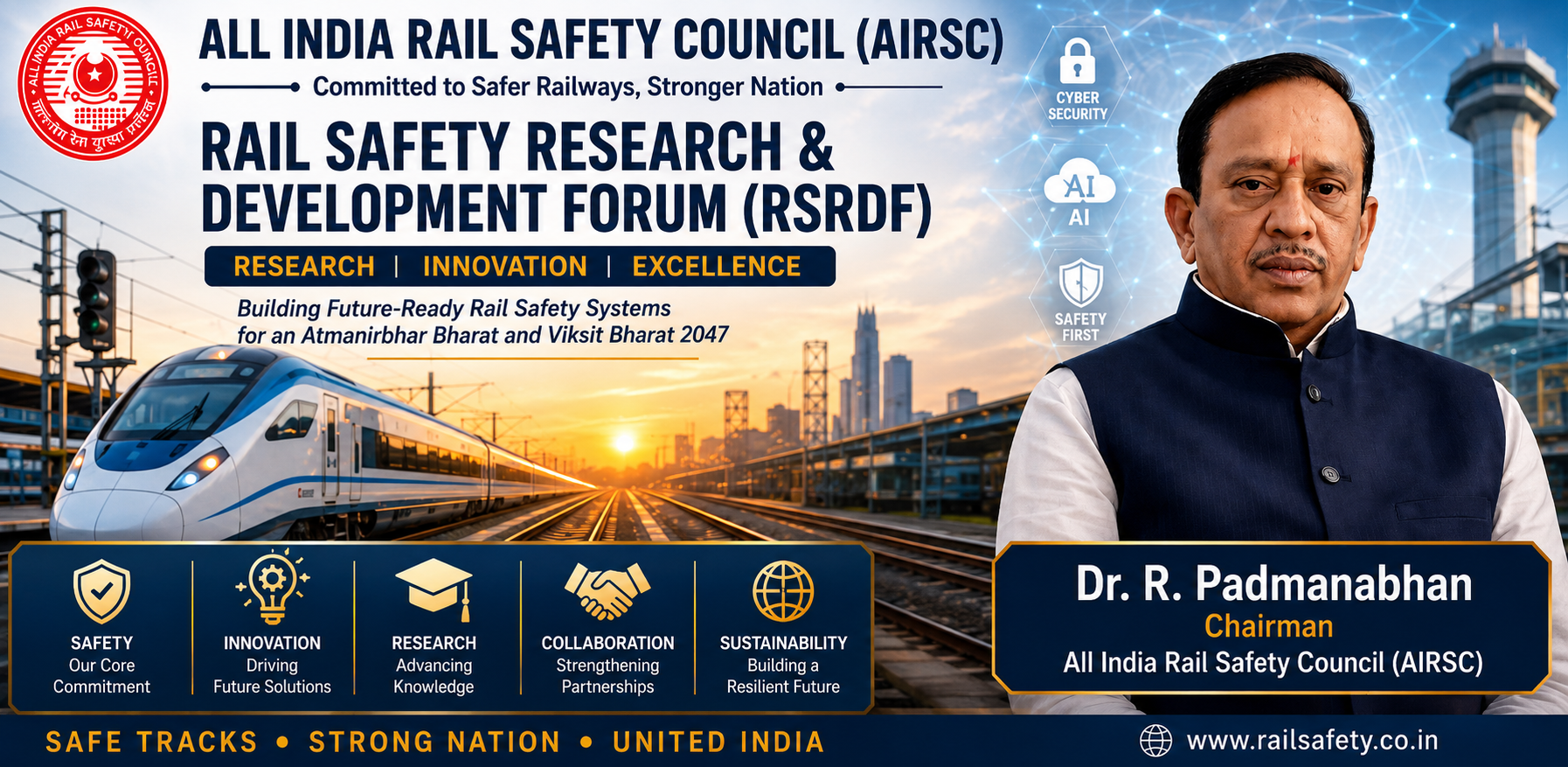
Chairman's Message Railways are much more than a transportation system—they represent one of the most critical pillars of national development, economic resilience, social integration, and strategic infrastructure. As India continues its remarkable journey towards becoming a globally competitive and developed nation, the railway sector assumes an increasingly significant role in connecting people, facilitating commerce, enabling industrial growth, supporting environmental sustainability, and strengthening national unity. In a country as vast and diverse as India, railway safety is not merely an operational responsibility; it is a national commitment. Every safe journey strengthens public confidence, every preventive measure protects lives, and every innovation in safety contributes directly to the nation's progress. A resilient, secure, and future-ready railway ecosystem is fundamental to achieving sustainable economic growth, operational excellence, and inclusive development. It is with this vision that the Rail Safety Research and Development Forum (RSRDF) has been established as a premier knowledge-driven initiative of the All India Rail Safety Council (AIRSC). The Forum has been conceived as a strategic national platform dedicated to advancing research, innovation, policy development, technological excellence, and professional collaboration in the field of railway and metro safety. Our objective extends beyond conventional safety management. We seek to cultivate an ecosystem where scientific research, practical experience, technological innovation, evidence-based policymaking, and professional expertise converge to create safer, smarter, and more resilient railway systems. The Forum aspires to become a national centre of excellence that promotes continuous learning, interdisciplinary research, and international collaboration while addressing both current and emerging challenges facing modern railway operations. The rapid transformation of railway infrastructure through high-speed rail corridors, Dedicated Freight Corridors, metro rail expansion, digital signalling, intelligent transportation systems, artificial intelligence, predictive maintenance, automation, cybersecurity, and smart mobility solutions has fundamentally changed the safety landscape. These advancements demand a corresponding evolution in safety governance, risk management, and operational resilience. Traditional compliance-oriented safety practices, while important, are no longer sufficient to address the complexities of twenty-first-century railway systems. Today's environment requires predictive, proactive, data-driven, human-centric, and systems-based approaches that anticipate risks before incidents occur. The Forum therefore promotes modern safety methodologies including: • Predictive Risk Assessment and Safety Analytics • Human Factors Engineering and Behavioural Safety • Artificial Intelligence and Machine Learning Applications • Big Data Analytics for Safety Decision Support • Digital Twin Technologies and Smart Infrastructure • Cybersecurity for Railway Operations and Critical Infrastructure • Climate Resilience and Sustainable Railway Systems • Disaster Risk Reduction and Emergency Preparedness • Business Continuity Planning and Operational Resilience • Integrated Safety Management Systems and Safety Culture Development The Forum also recognizes that sustainable safety cannot be achieved through technology alone. A strong safety culture depends upon competent professionals, informed leadership, ethical governance, organizational learning, and continuous capacity building. Through research publications, technical conferences, policy dialogues, professional certification programmes, knowledge-sharing platforms, collaborative projects, and strategic partnerships, we aim to build the next generation of railway safety leaders who are capable of addressing future challenges with confidence and competence. Our vision aligns closely with the national priorities of Atmanirbhar Bharat, encouraging indigenous research, home-grown technological innovation, domestic capability development, and self-reliance in railway safety technologies. Simultaneously, the Forum actively contributes towards the aspirations of Viksit Bharat 2047, where world-class infrastructure must be supported by globally benchmarked safety standards, resilient governance frameworks, and internationally recognized operational excellence. The Forum is equally committed to supporting India's obligations towards sustainable development, climate resilience, digital transformation, and international cooperation. It seeks to facilitate meaningful collaboration among policymakers, railway administrations, metro rail organizations, regulators, accident investigation agencies, academic institutions, research organizations, technology providers, professional bodies, industry experts, workforce representatives, and civil society organizations. By fostering multidisciplinary partnerships and encouraging global knowledge exchange, the Forum aims to ensure that India remains at the forefront of railway safety innovation while contributing constructively to the international rail safety community. Safety is not simply the prevention of accidents—it is the creation of resilient systems, responsible leadership, informed decision-making, and a culture of continuous improvement. Every research initiative undertaken, every technological innovation developed, every professional trained, and every policy recommendation advanced through this Forum represents another step towards protecting lives, enhancing operational efficiency, strengthening public confidence, and securing the future of India's railway network. As Chairman of the All India Rail Safety Council, I firmly believe that leadership in railway safety is leadership in nation building. Investing in research, innovation, education, collaboration, and professional excellence is not merely an institutional responsibility—it is a national obligation. Together, we have the opportunity to shape a railway ecosystem that is safer, smarter, more sustainable, technologically advanced, and globally respected. I extend my sincere invitation to railway professionals, engineers, researchers, academicians, policymakers, industry leaders, innovators, students, and all stakeholders to actively participate in this important national mission. Through collective wisdom, shared responsibility, and unwavering commitment, we can build a railway system that not only meets the highest international standards of safety but also serves as a model of excellence for future generations. Let us work together to transform railway safety into a national movement driven by knowledge, innovation, integrity, and collaboration—ensuring that every journey is safer, every operation is smarter, and every advancement contributes to a stronger, more resilient, and more prosperous India. "Building Future-Ready Rail Safety Systems for an Atmanirbhar Bharat and Viksit Bharat 2047." Dr. R. Padmanabhan Chairman All India Rail Safety Council (AIRSC)
Download PDF →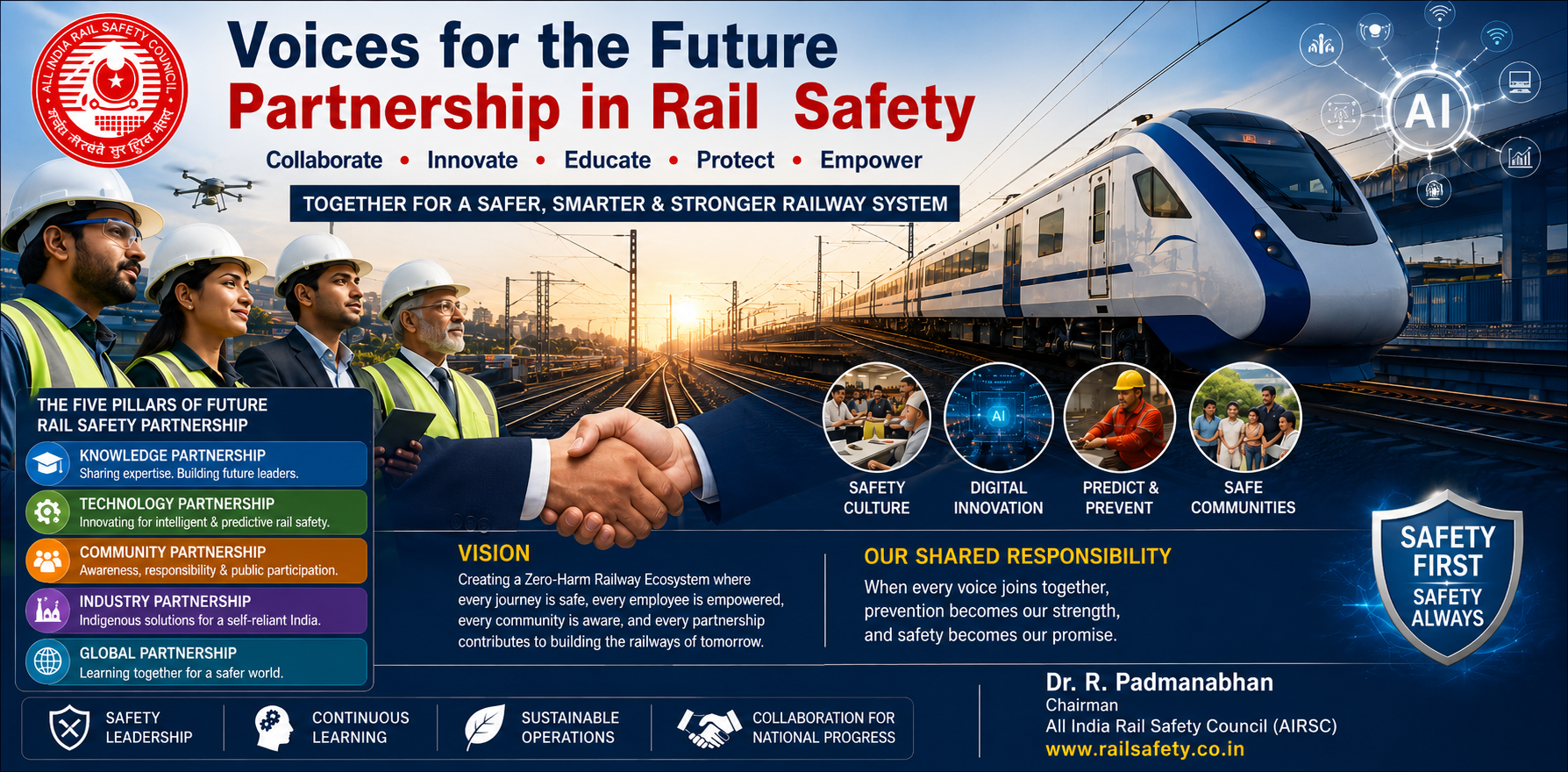
Voices for the Future Partnership in Rail Safety Railways are more than a mode of transport—they are the lifeline of a nation's economy, social progress, and sustainable development. Every day, millions of passengers and vast quantities of freight depend on safe, reliable, and efficient railway systems. As railway technology rapidly advances through Artificial Intelligence, digital signalling, predictive analytics, automation, and high-speed mobility, the responsibility to strengthen safety must evolve with equal commitment. "Voices for the Future Partnership in Rail Safety" is a vision that calls upon every stakeholder to work together in building a resilient, technology-driven, and people-centered railway ecosystem. True rail safety is achieved not by a single institution but through collaboration among governments, railway administrations, industries, educational institutions, researchers, technology innovators, emergency response agencies, employees, passengers, and local communities. Why Partnership Matters Modern railway systems are becoming increasingly interconnected and complex. Challenges such as increasing passenger volumes, climate change, cyber threats, infrastructure modernization, human factors, and operational risks require collective solutions rather than isolated efforts. International experience consistently shows that cooperation among infrastructure managers, operators, researchers, regulators, and technology partners accelerates safety innovation and strengthens operational resilience. A future-ready railway requires partnerships that promote: Safety-first organizational culture. Continuous learning and professional development. Research-driven decision making. Digital transformation and innovation. Transparent reporting and risk management. Community participation in railway safety awareness. Sustainable and environmentally responsible operations. The Five Pillars of Future Rail Safety Partnership 1. Knowledge Partnership Sharing expertise among railway professionals, academic institutions, research organizations, and training academies to develop future railway leaders equipped with global best practices. 2. Technology Partnership Promoting Artificial Intelligence, Internet of Things (IoT), predictive maintenance, intelligent signalling, advanced communication systems, digital twins, cybersecurity, drone inspections, smart surveillance, and data analytics to prevent accidents before they occur. 3. Community Partnership Rail safety begins with public awareness. Schools, colleges, passengers, residents near railway tracks, and local communities must actively participate in safety education, trespass prevention, level crossing awareness, and emergency preparedness. 4. Industry Partnership Manufacturers, infrastructure companies, engineering consultants, start-ups, and technology providers should jointly develop indigenous, reliable, and globally competitive safety solutions that support the vision of Atmanirbhar Bharat. 5. Global Partnership Railway safety challenges are universal. International cooperation enables knowledge exchange, harmonized standards, collaborative research, and adoption of innovative technologies that improve safety performance across borders. AIRSC's Commitment The All India Rail Safety Council (AIRSC) is committed to becoming a national platform that connects government institutions, railway professionals, educational organizations, industries, researchers, emergency responders, and citizens through meaningful partnerships. AIRSC will continue to promote: National Rail Safety Awareness Campaigns. Professional education and certification. Research and innovation initiatives. School safety programmes through Rail Vidya. Industry-academia collaboration. Safety leadership development. Disaster preparedness and emergency response training. International technical cooperation. Digital rail safety transformation. Capacity building for future railway professionals. Creating the Railway Workforce of Tomorrow The future railway professional must possess more than technical expertise. Tomorrow's workforce should demonstrate: Safety leadership. Ethical responsibility. Critical thinking. Digital competency. Environmental consciousness. Emergency preparedness. Continuous learning. Innovation mindset. Collaborative decision-making. Commitment to public service. The objective is not merely to produce qualified personnel but to develop responsible safety leaders capable of protecting lives and strengthening national infrastructure. Our Shared Responsibility Every railway employee, engineer, station manager, train operator, maintenance technician, policymaker, researcher, contractor, passenger, parent, teacher, and student has an important voice in shaping the future of railway safety. When every stakeholder contributes knowledge, experience, innovation, and responsibility, railways become safer, stronger, smarter, and more sustainable. The future of railway safety belongs to those who believe that prevention is always more valuable than response, collaboration is stronger than isolation, and safety is the foundation of national progress. Vision Statement "Voices for the Future Partnership in Rail Safety is a national movement that unites people, technology, innovation, education, and leadership to create a Zero-Harm Railway Ecosystem where every journey is safe, every employee is empowered, every community is aware, and every partnership contributes to building the railways of tomorrow." Chairman's Message "Rail safety is not merely an operational requirement—it is a shared national responsibility. Together, through partnership, innovation, education, and unwavering commitment, we can build a future where every railway journey reflects excellence, trust, resilience, and the highest standards of safety. Let every voice become a force for safer railways and a stronger India." Dr. R. Padmanabhan Chairman All India Rail Safety Council (AIRSC) www.railsafety.co.in
Download PDF →